
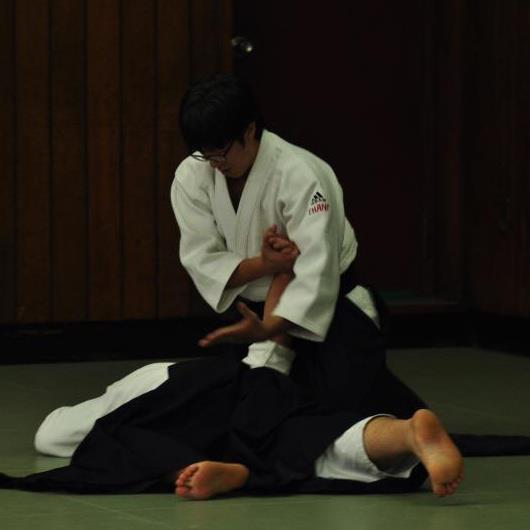
Take an Aikido class and you’ll be met with a flood of unfamiliar Japanese technique names like “irimi-nage” and “shiho-nage.” They’re daunting to memorize at first, but once you understand what the names mean, the techniques themselves become much easier to grasp. Here’s a rundown of the basic technique names beginners encounter most often.
Katame-waza: Techniques That Control the Joints
Ikkyo (一教) through Yonkyo (四教) form the basic group of techniques that subdue an opponent by controlling the elbow and shoulder joints. The numbers don’t indicate difficulty — they refer to differences in how the joint is controlled. Gokyo (五教) is mainly used to control a wrist gripping a weapon.
Nage-waza: Techniques That Throw an Opponent
- Irimi-nage (入身投げ): True to its name — “irimi” meaning “entering the body” — this technique throws by stepping directly into the opponent’s space.
- Shiho-nage (四方投げ): As the name “four directions” suggests, this technique rotates the opponent’s arm so they can be thrown in virtually any direction.
- Koshi-nage (腰投げ): A technique that uses the hip (koshi) to lift and throw an opponent as if carrying them on your back, similar in principle to Judo’s shoulder throw.
- Kokyu-nage (呼吸投げ): True to its name, “breath throw” uses flow and timing alone — without a fixed joint lock — to break the opponent’s balance.
Terms That Describe How the Attack Is Made
Technique names are often preceded by a term describing how the opponent attacked. For example, “katate-dori (片手取り)” means the wrist was grabbed with one hand, while “ryote-dori (両手取り)” means both wrists were grabbed. So “katate-dori irimi-nage” means “responding to a one-handed wrist grab with irimi-nage.”
Tips for Memorizing Them
Rather than trying to memorize every name at once, it’s more effective to review the names of the techniques covered in that day’s class, one class at a time. Understanding the meaning behind each name makes it stick far better than rote memorization. Over time, a moment comes when your body reacts before you’ve even consciously registered the name.