

I post Aikido videos on my YouTube channel from time to time.
Reading comments praising Aikido, or saying a video was fun to watch, always lifts my mood and makes me want to work even harder on the next one.
But not every comment is a kind one.
Some comments call Aikido fake, or say a technique in a video looks made up and doesn’t make sense.
Even I sometimes think, “Yeah, nobody’s going to believe this one.”
Recently, some comments criticizing Aikido showed up on the Jeju Oseung Dojang YouTube channel.
Most of these comments start out debating whether Aikido is “practical,” and end up turning into personal attacks.
A common pattern: someone who has barely tried Aikido — or never tried it at all — starts putting it down, and the conversation eventually turns into “prove it by winning a tournament.”
It’s like someone who didn’t enjoy a certain food deciding that anyone who does enjoy it is a fool — when all they had to do was simply not eat it themselves.
Responding to every one of these comments does take a toll on my mood, honestly.
People around me often tell me not to bother replying to attention-seekers like that.
Aikido was not created to win competitions.
And it was even less created to prowl around picking fights like a street thug, looking to beat people up just because they annoyed you.
The essence of Aikido is not creating a reason to fight in the first place.
Every technique expressed or practiced in Aikido is about finding and training the best possible response to violence coming from an outside force.
Rather than meeting violence with violence, it seeks a way to avoid it and neutralize it.
Aikido is a martial art built around finding a kinder path than “an eye for an eye, a tooth for a tooth.”
Training at the dojo means studying techniques and analyzing an opponent’s force in search of that better, kinder way.
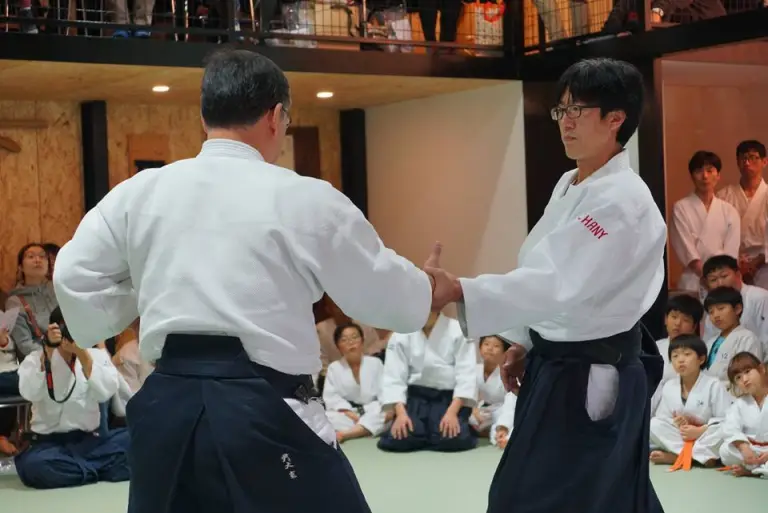
Some people pick a fight over this by asking, “Who actually grabs someone’s wrist in a real fight?”
There are several reasons Aikido uses wrist grabs.
One is to feel, through being grabbed, that your own power has been blocked — and to understand how the opponent’s force connects to your center.
Among many reasons, a wrist grab is simply the easiest way to understand those two things.
The techniques expressed through wrist grabs aren’t meant to say “this is how you’d handle it as self-defense.”
Once you understand, through a wrist grab, how your own power gets blocked and how the opponent’s force connects to your center, a technique performed correctly will work no matter how the opponent grabs you.
If you try to memorize techniques the way you’d memorize a multiplication table, the list of techniques to memorize just keeps growing.
Learning that many techniques requires a high level of physical fitness, which is exactly why people naturally give up as they get older.
But once you understand the underlying principle of multiplication, division comes naturally too.
Every technique in Aikido connects back to finding where an opponent’s attack links into your own body, and resolving that root cause.
That’s why it’s nearly impossible to understand what Aikido is really pursuing after just a “few days” of training.
Of course, there’s nothing wrong with seeking out a gym that specializes in techniques purely to win fights — the same way someone might go to a top-ranked math tutor just to score higher than the kid next to them.
But it’s important to understand that Aikido was not created to help you beat your friends, or to make you a better fighter than the people you train alongside.
Aikido is a martial art created so that people can share it, study it together, and find happiness through it.
People often mock it, saying “Aikido is just something old folks do.”
Aikido is one of the few martial arts you can practice when you’re young and just as well when you’re old.
Being something you can still practice in old age proves it’s a martial art where, through years of training, you can sweat and connect with much younger practitioners as equals.
About three or four times a year, seminars are held led by senior instructors well into their 80s.
Through Aikido, we get to learn from the wisdom of these elder teachers.
Many say Aikido has helped them a great deal in their social and professional lives too.
Life is the real deal, Jong-man.
It’s a line often said as a joke, but everyone knows deep down it’s true.
For Aikido, “the real deal” means striving to live a happier, more joyful life.