
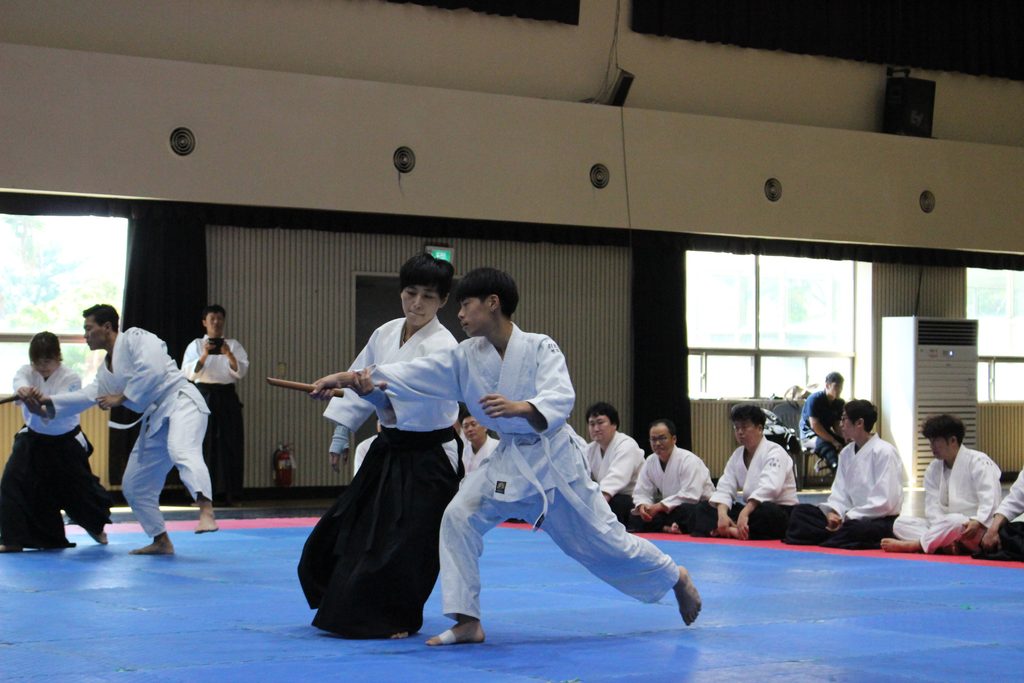
Not long ago, my hakama finally reached the end of its life. A hole had worn through at the knee.
I first wore a kendo hakama handed down by a senior at my dojo when I earned my shodan, then bought one of my own for aikido around 2015 — so this hakama and I had trained together for nine years.
I throw away things that are old or worn or haven’t been used in a long time without a second thought, yet I could never quite bring myself to throw away my dogi, no matter how worn it got or how long it sat unused. They carry all the effort, sweat, and memories I put into them…
So this time too, rather than throw the hole-worn hakama away, I patched it here and there and pressed on with my preparations for the exam. (Stay with me until the 4th dan test, at least.)
Thirteen years, by count.
Has there ever been anything else I kept doing this steadily, for this long?
What is it about aikido that could keep me practicing this martial art for so long?
How have my values and my life changed through practicing aikido?
With my 4th dan exam — my last technical examination — coming up, many thoughts drift through my mind.
One thing I can say for certain: aikido has now become a (comfortable) part of my everyday life.
Until I was allowed to test for 3rd dan, I carried a bit of an obsession that “I have to go to the dojo every day.” On days I couldn’t make it — because of work, childcare, whatever it was — I’d get frustrated, convinced I was falling behind, and all kinds of negative feelings would shake me.
And the days I did make it to the dojo weren’t much better. If the workout wasn’t hard enough for my liking, or if a technique just wouldn’t come together, that soured my mood too.
Looking back now, I wonder why I pushed myself so hard.
Back then I didn’t understand that if I couldn’t make it to the dojo today, I could simply go tomorrow, and that if a technique wasn’t working, it just meant that was the level I was at right now — nothing more.
Having come through that precarious period, my heart feels much lighter now on the way to the dojo.
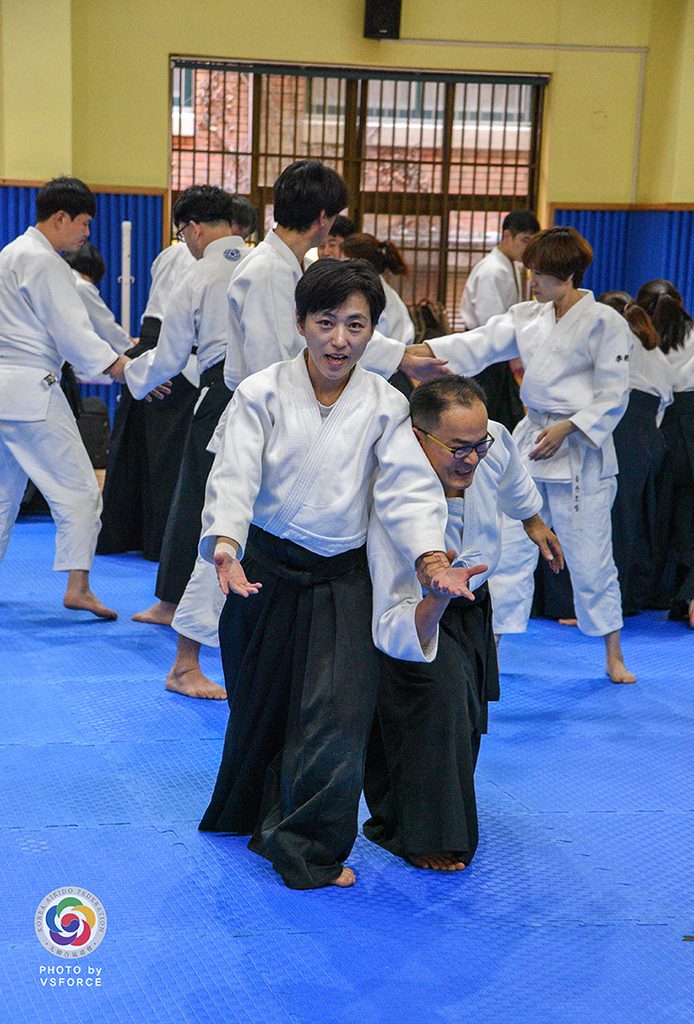
The topic of my 4th dan thesis is “How to Teach Beginners.”
Honestly, I don’t yet run my own dojo, and my only experience teaching is having led a few classes when the dojo head was away, so I do feel a fair amount of pressure writing about teaching beginners. Every time I sat down to write, I’d open a blank document and nothing would come, so I kept putting it off — until I couldn’t put it off any longer and sat back down at the computer. (Today, I will finish this, no matter what.)
I still vividly remember the days I spent agonizing over building a curriculum, the first time I had to give rather than just receive. I sometimes pull out the notes I scribbled back then, and seeing how much passion was packed into them always makes me smile.
Drawing on ① my (admittedly slight) teaching experience, ② what I’ve seen and felt attending seminars, training camps, and other events at home and abroad, and ③ the thoughts that have occasionally crossed my mind about how I’d lead members if I ever had my own dojo, I’ve tried to put together some thoughts on how best to teach beginners.
1. Share aikido’s mission, vision, and core values.
Mission, vision, and core values are terms that come up whenever people talk about running a business. They act like a compass, pointing the organization in the direction it should go. But because making money has to come first for a business to survive, most companies end up overlooking these and focusing solely on the bottom line.
※ For reference — Mission: why you do this in the first place, your ultimate purpose
Vision: what you’re heading toward, your plan for the future (what you aspire to look like)
Core values: the standards you hold yourself to in order to get there
Even so, mission, vision, and core values serve as the anchor of a company’s management and help everyone in the organization look in the same direction — which is exactly why setting a vision, mission, and core values is essential to running a company successfully over the long term.
Now, let’s swap “company” for “dojo” and think it through again.
If you’ve trained long enough to be sitting for a 4th dan exam,
if you have enough conviction and sense of responsibility toward aikido to run your own dojo, then you almost certainly already have your own mission, vision, and core values for aikido, in your own way.
Let’s share and pass on those values — the ones shaped over the years through training and conversation with our teachers and our senior and junior training partners — to our beginners as well.
There’s no need to set aside special time for it. I think it’s enough to bring it up now and then, in the small pockets of time during training.
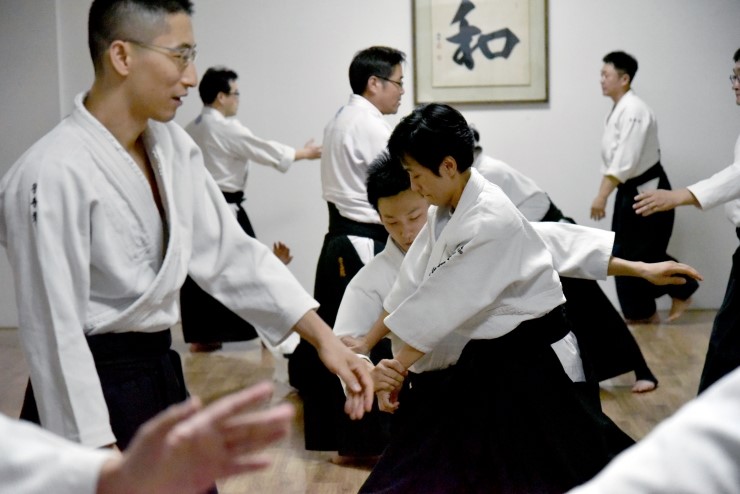
People come to the dojo for all sorts of reasons.
To lose weight, to relieve stress, because they saw it somewhere and thought it looked cool — and so on.
They start out full of ambition, but once life gets in the way and training becomes hard to keep up, the thought inevitably creeps in: “Why am I even doing this?” Whether someone finds an answer to that question at that moment determines whether they keep training or, as most do, quit.
I never found that answer in technique. I found it in the conversations I had, now and then, with my teacher and my seniors. Listening to how they approached aikido, how they lived in the present and pictured their future, gave me the strength to get back up. If the relationship had been built on technique alone, I doubt I could have gotten through those stretches on my own.
When members of the same dojo
share the same (or similar) way of thinking,
understand each other’s thinking,
and empathize with each other’s thinking,
they can push through any difficulty and keep training with a joyful heart.
2. Develop a curriculum for beginners.
① Everything is hard for everyone at first. So add elements that make it fun instead.
Aikido techniques will feel completely unfamiliar the first time. Unless someone has done a similar practice elsewhere, most beginners mix up their left foot and right foot, let alone irimi, tenkan, or kaiten. Ask a beginner how their first class went and they’ll usually say, “It’s fun, but it’s hard.” Our job is to add enough fun that the sentence never shrinks down to just “It’s hard.”
I was once given time to teach a ukemi class.
When a technique is applied, uke shouldn’t lean on their partner — they need to try to hold their own posture under their own power. That’s because, the instant the pin releases, they need to already have their own center secured so they can launch straight into the next attack. (At least, that’s how I see it.)
While planning a curriculum around this idea, I wanted to find a way to keep participants engaged and having fun rather than getting bored, so at one point I added a limbo-style exercise using a bo staff.
We’d first have people check, on their own, how far back they could bend under their own power, and then move into (side) irimi-nage, shiho-nage, and the like with a partner. It was, by far, the session with the most laughter I’ve ever heard during training. Even years later, that’s still the one training day I remember clearly — which tells me it must have been pretty fun for me too.
Aiki dance is another good approach. At our dojo, once a beginner has joined and reached the point where they can tell irimi, tenkan, and kaiten apart, we have them try aiki dance — and beginners who were hopelessly confused suddenly handle irimi, tenkan, and kaiten just fine. It feels less like doing a technique and more like dancing, so they can enjoy it without the pressure of “getting the technique right.”
② Give equal weight to training nage’s role and training uke’s role.
Case 1. Being small and, let’s say, not very strong (?), I sometimes end up as the test subject for large, powerful beginners. If a big, strong beginner has done another martial art before, that’s actually easy — they attack properly, so I can simply use that attack to apply the technique. But if they’re only big and strong, without that background, it’s a different story. They just clamp down on my poor wrist, daring me to try something, and hold on until my hand goes white from lack of circulation.
Case 2. A beginner with no strength behind them at all (this describes most beginners). They only mimic the motion of the attack without putting any real force behind it.
Both cases are difficult partners for practicing aikido technique. Aikido is a martial art that safely subdues an attacker by using the attacker’s own force, so technique simply doesn’t work on someone who isn’t actually attacking. These days, with a bit more experience under my belt, I can explain the underlying principle and coach the person into attacking properly so we can keep training. But when I had just become a black belt, there were plenty of times a technique flatly refused to work on my partner, and I found that bewildering. That led me to force techniques onto people, and in the process both of us ended up hurting each other — physically and emotionally.
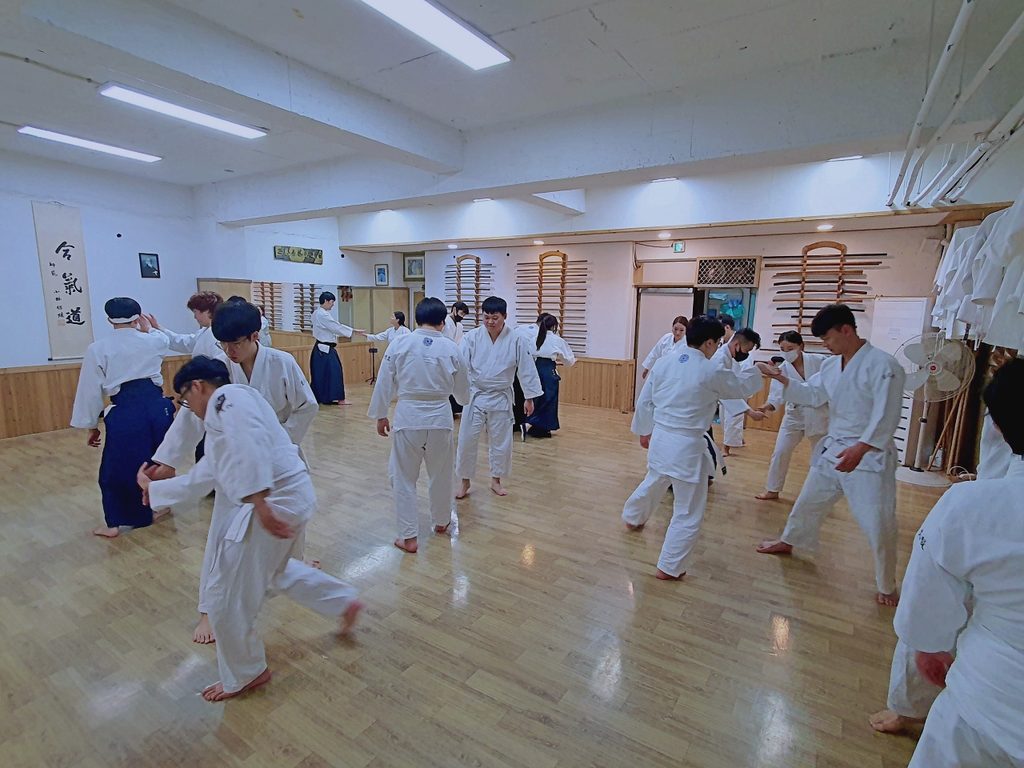
Someone gets curious about this thing called aikido and comes looking for a dojo. Wanting to experience it firsthand, they join up and put on a dogi. If they’ve done a similar practice before, or simply have good athletic instincts, they’re already captivated by the end of the first day — they immediately realize their own strength is useless, that it’s being turned back on them.
The problem is the two cases above, where no real attack ever happens and the beginner never actually feels the technique. All they can do is copy the motion being demonstrated in front of them.
For that latter group especially, we need to let them feel an actual aikido technique before more time passes and they lose interest — and I think the best way to do that is to teach beginners uke’s role before nage’s.
Uke’s primary role is to be “the attacker.” A proper attack is, in fact, a necessary condition for aikido to even work, and yet the truth is that up to now most of our training has been weighted heavily toward nage’s technique.
I took a great deal away from a seminar led by Umetsu Sho Sensei from World Headquarters. For a single technique, he explains nage’s expression of it and uke’s expression of it at the same time, so each side can clearly see what they should focus on in their own role. I wasn’t used to being taught that way, so the first Umetsu Sho seminar I attended was a genuinely refreshing shock. I think this style of teaching is well worth learning from.
When a technique doesn’t come together, it might be nage’s shortcoming, but it might just as easily be uke’s — as instructors, we need to always keep that in mind, and starting now, we need to put more weight on training uke’s role.
In that sense, it’s genuinely encouraging that dedicated ukemi seminars have been held on a regular basis recently.
③ Hold a “special feature” event once or twice a month.
Pick one technique that beginners find difficult, or one that would especially help them, and run a special feature event that trains that technique intensively — a “day of ukemi,” “kotegaeshi deep dive,” and so on.
It would also be good to sit down together after training and talk freely about what people found difficult during practice and what technique they’d like the next special feature to cover.
3. Even a whale will dance if you praise it.
Anyone who does something well and gets a positive response naturally wants to keep doing it.
Don’t judge people against your own standard — if there’s even the slightest improvement from where they stand, offer them a word of praise without hesitation. What matters here is the process: continuing to notice the small ways they’re getting better, acknowledging it, and encouraging them to keep it up.
Be careful not to fall into the trap of saying nothing when they’re doing well and only speaking up when something’s off. If there is something that isn’t working, try leading with something positive first before getting into it.
4. It’s never too late to teach someone something once they actually want to know it.
When you see a beginner — especially one who’s working harder than anyone else — it’s tempting to want to teach them just one more thing. That’s exactly the moment to be careful.
If someone isn’t asking questions, odds are they don’t yet know enough to know what they don’t know. It’s enough to wait until the beginner raises a question themselves, and answer it then.
One teacher at the dojo — the dojo head, or whoever has been temporarily delegated teaching authority — is enough. If everyone jumps in to teach at once, it can be confusing for a beginner. Let’s not forget that they don’t yet realize the same technique, taught by the same teacher, can still look different depending on who’s performing it.
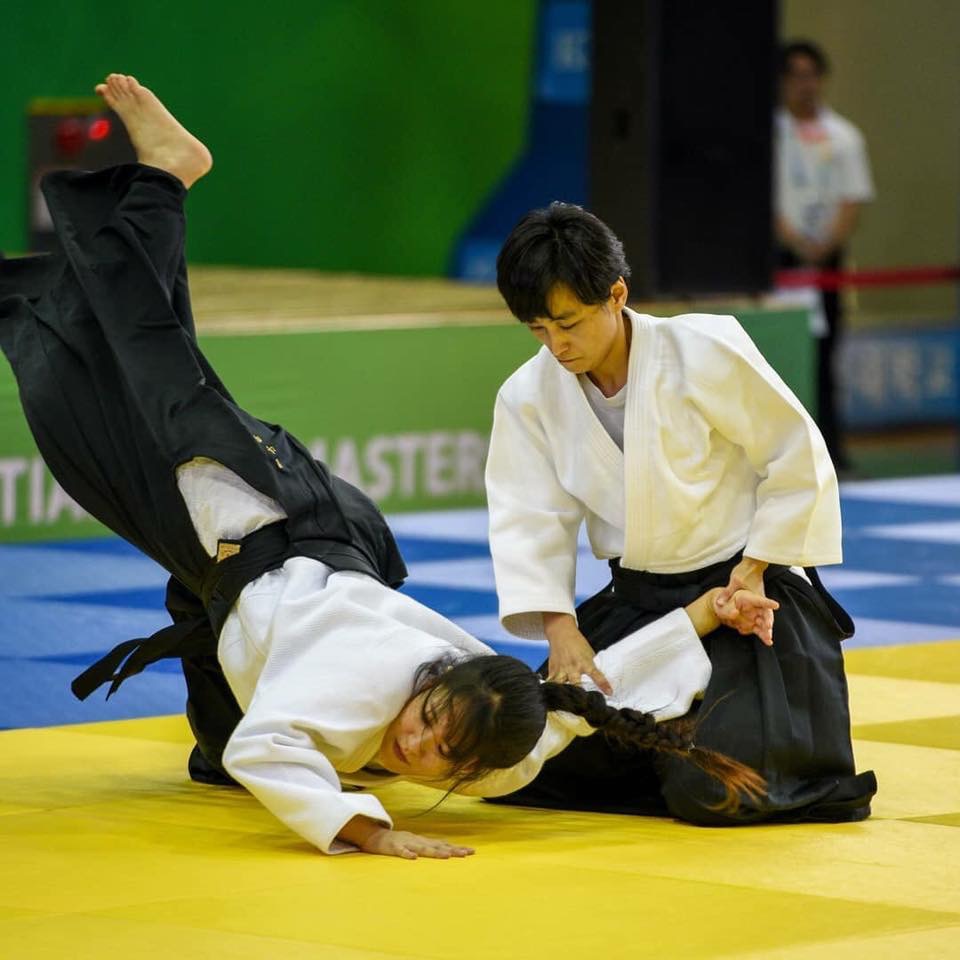
5. It’s hard, but we keep going anyway. That’s exactly what we’re doing right now.
Looking back over my years of training, progress in technique hasn’t been a steady upward line so much as a J-curve. It would be nice if the results always matched the effort, but there have been stretches where the harder I worked, the harder things got — periods when, no matter how much I tried, my skill seemed stuck in place, and my spirit sank right along with my body. And yet, when I kept showing up to the dojo through all of that, at some point I’d notice my movements had gotten lighter. That, I think, is when the real technical growth happens. Sometimes all you need to do is endure a little longer and keep going.
But most people give up right in that punishing stretch. The higher your rank, the more times you go through this cycle, and the more inner strength you build to push through it on your own — which is exactly why beginners, who haven’t built up that resistance yet, need extra attention and care.
So that no beginner quits simply because they’ve worn themselves out, let’s regularly check in on what they’re finding difficult about training aikido, and keep thinking about — and acting on — how we can help.
If you asked me to name the single hardest thing in the world, I wouldn’t hesitate: “continuing.”
Continuing even when it’s hard, even when you want to quit. That’s exactly the hard thing we’re doing right now. I believe that if we keep going, we’ll be able to do it, and that a day will come when we’re finally good at it.
One day in August 2023
Jeju