
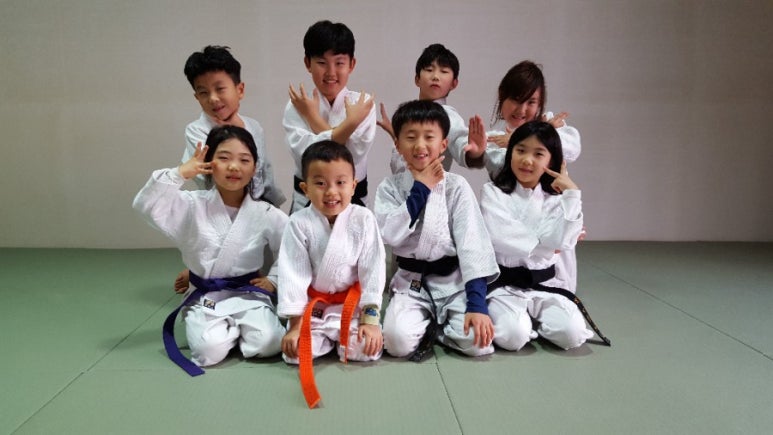
Aikido is a martial art that redirects an opponent’s force by moving in harmony with their motion, rather than overpowering them with strength.
Because of its characteristic of having no strikes or rough contact, more and more parents are recently turning their attention to Aikido as part of children’s education.
Let’s take a careful look at what real effects practicing Aikido can have on children, and what’s good to know before starting.
An Exercise That Builds Bodily Balance and Coordination
Aikido involves many circular and rotational movements, so through repeated practice, children naturally develop a good sense of balance and body control.
In particular, if children learn breakfalls (ukemi) from an early age, their bodies remember how to fall safely, which greatly helps prevent injuries during play or in daily life.
In fact, instructors often report that children who have practiced breakfalls for a long time instinctively take a protective posture even when falling on stairs or icy roads. Aikido’s breakfalls not only teach children how to fall safely but also how to get back up again. This becomes very helpful for mental resilience even after they grow into adults.
For growing children, it is also a full-body exercise that develops flexibility and core strength together, and since it involves mastering techniques through balanced use of both left and right sides, it has the added benefit of naturally producing a more symmetrical physique. Additionally, because children learn to use their joints—wrists, elbows, shoulders—gently and fluidly, the risk of growth pain or joint strain is relatively low.
Emotional Stability and Focus
Aikido training centers on repeating set forms (hyeong) while coordinating breathing and movement, so the habit of naturally concentrating becomes ingrained in the body.
Another distinctive feature is that, since matches are not about winning or losing, children can build a sense of accomplishment at their own pace without the stress of competing to win or lose.
Since there are goals like belt promotions and rank tests, children do feel a sense of accomplishment, but there’s little room for them to feel discouraged from comparing themselves with friends.
Many instructors often share stories about how children who used to be restless gradually calm down from the moment they put on their dobok (uniform) and bow in greeting.
It is said that the experience of repeatedly moving one’s body within the defined space and rhythm of the dojang has a stabilizing, rhythmic effect on children who are emotionally impulsive.
Time to Learn Courtesy and Consideration Through the Body
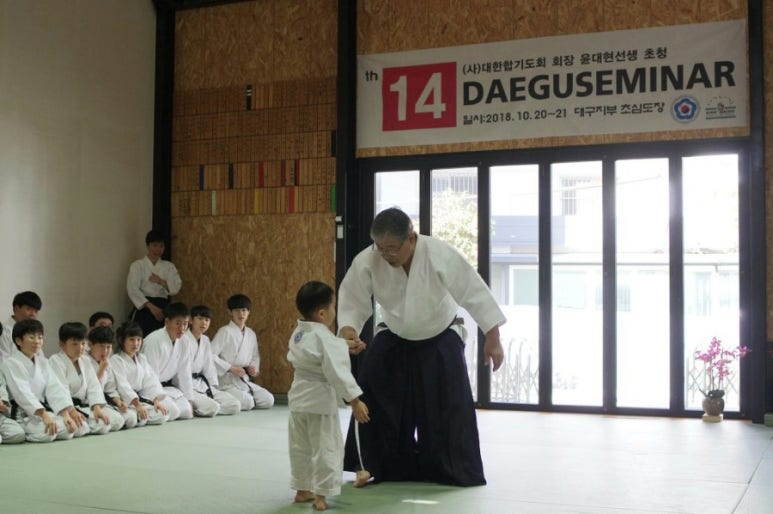
Aikido training only works when there is a partner. Techniques are exchanged in pairs, and the consideration not to hurt one’s partner becomes ingrained in the body.
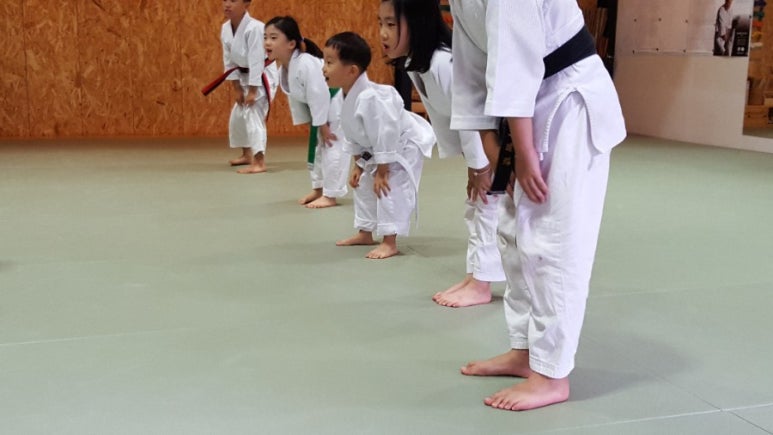
The etiquette of bowing when entering and leaving the dojang, and before and after exchanging techniques with each other, is training to naturally instill repeated courtesy and consideration.
Since the goal is not to defeat the opponent with strength but to achieve harmony with them, this often carries over into everyday relationships, leading to attitudes of yielding and cooperating with others.
Whether a child is strong or weak, they practice the same forms together, and one unique feature of Aikido is that children first learn the feeling of “working together in harmony” rather than the sense of superiority that comes from “being stronger.”
How Does It Compare to Other Martial Arts?
Martial arts that involve sparring (free fighting) have the advantage of building competitive spirit and instantaneous reaction ability, but for children who feel burdened by the competition itself, this can become a source of stress.
Since Aikido centers on form (hyeong) training in which techniques are exchanged with a set partner in a set order, there is almost no pressure to win, making it a good choice for children who are timid or introverted to start without feeling burdened.
Conversely, compared to martial arts that involve sparring, the pace at which instantaneous reaction and reflexive response abilities are developed may feel relatively slower, so it’s worth considering running it alongside or comparing it with other martial arts depending on the child’s disposition and goals.
What Parents Should Know
- Most dojangs generally start classes around ages 5–7, focusing on basic physical fitness and play-based lessons.
- Since there are no strikes or intense sparring, the risk of injury is relatively lower compared to other martial arts.
- It’s a good idea to visit and observe in advance whether the dojang runs a separate children’s class, or whether the instructor teaches in a way tailored to children’s eye level.
- Since the first few weeks focus mainly on breakfalls and basic stances, it also helps to gently manage a child’s expectations if they ask, “When will I learn cool techniques?”
- If it’s a dojang where parents can train together with their children, it can also be a great opportunity to share a family hobby.
How to Prepare for the First Trial Class
Most dojangs offer a trial class before formal registration.
Comfortable athletic wear that allows easy movement is sufficient preparation, and since many practice barefoot, it’s good to trim the child’s hand and toe nails beforehand.
During the trial class, it’s helpful to carefully observe whether the child follows the instructions of an unfamiliar adult (the instructor) well, and how they react in situations involving bumping into other children—this can help determine whether the dojang is a good fit for your child. The most important standard, more than anything else, is whether the child themselves shows a reaction of “that was fun.”
Recommended for Children Like These
- Children who want to train their bodies without intense physical contact
- Children who want to reduce restlessness and develop calm concentration
- Children who want to naturally learn courtesy and consideration while playing and having fun with friends
- Children who want to build a sense of accomplishment at their own pace rather than through competition
- Children who want to learn how to fall safely without getting hurt
Ultimately, the greatest influence Aikido has on children is not the flashy techniques themselves, but rather the attitude of body and mind that allows one to safely get back up even after falling. The experience of not being intimidated by winning or losing, and of matching breath with a partner, quietly permeates the way a child builds relationships even outside the dojang.